RSS


Get glimpses of the writing life of Christa Brassington, including novel excerpts, writing advice, sobering rejections and (hopefully) joyful acceptance, alongside basic writerly observations. All here on Writer Wise.

Getting Unstuck

Before I reached the half-way mark (25,000 of 50,000 words) during this NaNoWriMo, I felt truly stuck. I didn't want to sit down at my computer because I wouldn't even be able to pick up from where I was without feeling like I was fumbling my way around, and I was afraid of putting down thousands of words that would be useless to my story. I knew my ending, knew where I was headed with my story, but didn't know what should go in the middle to get me there.

So, I fell back on my safety net and refreshed myself with a very helpful YouTube video of Dan Wells on Story Structure. (watch it here) It is rich with example plot lines from familiar stories, and he walks you through how to get your own story structured, working with intuitive building blocks, rather than chronological. It's great. I worked through my snags, filled in that gap in the middle of my novel and even realized a subplot that was lurking on the sidelines that would help bind the whole thing together. Now I am back on track, with almost 34,000 words drafted. Woo Hoo!

I am noticing a trend of the most important tools I'm using this time around, very similar to 2011.

Post-it notes! I have them stuck to the wall beside my desk, each one a visual representation of a chapter. I have the POV character listed first, then a brief snippet of what happens in that chapter. They are lined up in order, so I can grab one and enter it into Scrivener's notecards when I'm ready to tackle that chapter and I'm off to a good start.

Timer is definitely a best friend again, setting fifteen minute increments (sometimes back-to-back) which helps me not feel overwhelmed, because it is only fifteen minutes, after all! And it keeps my fingers clacking away at that keyboard.

Another thing that I used in 2011 as well, but failed to mention...
Writer's Digest Weekly Planner. This thing is awesome. There is so much space for everything I need. There are 54 undated weeks-- which is perfect, because I was able to come back to the same planner and pick up with it, five years later!! Between each week there is a whole two-page layout for Goals, Notes, and Musings. Each day of the week has space enough for agenda items, and daily writing goals, because I LOVE CHECKLISTS. There are also helpful and encouraging essays, inspirational quotes, and seven sample query letters. If you are interested in getting one of your own, check it out here.

If you are a writer, I hope your words are singing along! Share what tricks you've used to get unstuck!

Back at It

Wow. A lot happens in five years. Five years! We moved houses, had a baby, took some vacations, lost our dog to cancer, and basically life took over.
Honestly, since our daughter was born two years ago, I had not worked on anything new. I did scrutinize my first manuscript, and scrutinize it again. Still it feels incomplete, like I am missing a key piece of motivation (perhaps on the page and off.) I am still passionate about that original project, but as it is the first in a planned series, I have to get it right. So, I set it aside, while I stretch my atrophied writing muscles.
I came across a Facebook memory from five years ago announcing I was going to participate in NaNoWriMo 2011, and it brought me back here. After reading my posts about that experience, it got me excited to take on the challenge once again, but this time with a standalone project.
The story seedling came on August 24th, 2015, while I read a passage in the Old Testament about God's covenant faithfulness, in the face of rebellion and spiritual adultery.
I know the date because I recorded the barest details of the concept, including a working first line, in Simplenote. (A free app, available for both Apple devices and Android, and also accessible online at Simplenote.com) Simplenote has been such an awesome tool for me because it keeps my files synced across all my devices. This is great for on the go notetaking. I love it.
So, I'm taking a lot of my own advice and I brainstormed for the last week of October and at midnight on the morning of November 1st, I sat at my computer and began to type. Here is where I began...

" 

Today they will change her name.
She can barely hold herself up, and several times she has been supported by the maids in the room- how many are there- three? She can barely think. Her head is weak. She presses a palm against her eye, where a throbbing ache is blooming. The image of her hand covered in his blood flashes into her mind and she pulls it away. She shudders at what she is responsible for. 

"

Two hours later-- I was shocked to see the time-- I had three chapters and 1,694 words. An on-target beginning to the challenge.
Here were a few personal tricks I applied to the night's writing:
>>>  I set a timer a few times just to keep my fingers moving.
>>>  I worked out point of view over a few scenes. This time I am not doing first person, but multiple POV in third person, separated, so far, by chapters as to keep from feeling like we're head-hopping.
>>>  I delved into my characters senses to give a true feel for what was happening internally and externally in a scene.
>>> I tried to surprise myself as often as possible with better story advancement than what I went into the scene anticipating.
>>>  And, I stopped in the middle of a clear moment so that I can pick up again, easily, tonight.

Keep watch for updates on my progress and additional snippets.

Now, I am off to slide back into the remainder of that suspended scene.

50,000 Words and Counting


Yay! I did it! 50,000 words and a day early, too. Woo Hoo! I'm well into my second installment in my series and feeling good about the outcome.

Here's what I learned from this NaNoWriMo experience--

1) Friends can be great allies, even when they're rooting against you.
The day before I began the challenge I asked my friends and family on Facebook to come up with something (reasonable, but not necessarily desirable) I would have to do for them should I fail to reach the goal.

As Jon Voight (playing bad-guy Jonas Hodges on 24's 6th season) said,
"Stress is the fertilizer for creativity."

That should be the motto of NaNoWriMo. We should all hang it on our walls.

2) Having even a bare-bones plan for what to tackle during writing hours is key.
Each day I would brainstorm leading up to my writing time. This was helpful because I tended to write in the evening, usually ten to midnight, but if you write in the morning, just brainstorm before going to bed so you have a skeletal checklist for the morning.
An example of a day's checklist follows~


Wall of Mirrors
[X]Unity Gatherings held in commandeered church bldgs stripped of any spiritual significance
[X]Gwenna’s gemstone (@ Samuel’s?)
[X] Arrival— feeling checked-over
[X] Meets Erin, gets tour, sees Wall of Mirrors, and Mirror that Matters

I found that on the few days when I went to the computer without any firm clue as that where I was going with the story, it took me much longer to reach my daily goal.

3) Ask for help. When you don't know something, ask anyone who might. Ask your mom, your grandma, ask your Facebook community, ask a stranger.
Some examples of things I asked when I was coming up dry or simply didn't know:
-- What was a chore that you hated or would have hated to get stuck with as a teen?
-- When you have an asthma attack, which would help-- cool air, or warm moist air?
-- What are the turn-wheel passageways called in submarines? Hatches?
Also, Facebook (probably other social networking sites, too) is a great tool for writing prompts. I asked my friends to give me partial sentences to work into my writing one night. I had so much fun with what they gave me. Make sure to reward your friends for participating by letting them see how you used what they submitted. I did this by posting a "Note" and giving collaborative credit where credit was due. I'll post it on here, soon, as well.

4) Daily writing with a goal in mind is a great benefit and achievable. If I do NaNoWriMo next year, or any month in between, I would plan further ahead and set up an incentive plan for when milestones are reached. As it was I just made up my reward system as I went. Not terribly bad. A Cinnabon was part of my Treat day for reaching my half-way mark.
And on that note, Goodbye NaNoWriMo November, Hello NaNoSubMo* December. :)

*National Novel Submission Month where I will take on the task of perfecting my query letter, chapter summaries and polishing the manuscript of my first novel and work to get it into the hands of a reliable agent who can be passionate about my project, too.

Watch My Progress Over the Month

NOTE: this post will remain at the top of my blog for the remainder of November, so scroll down to see new posts!!


Deadline: November 30th, 2011

Full Speed Ahead: using the "find" function and symbols to your advantage


In the world of feverish writing, (as in NaNoWriMo November, or any other time of year when you are trying to get your first draft down) you cannot afford to stop and work out every scene to perfection. The most beneficial thing you can do is keep moving forward, or at least down the page.

For NaNoWriMo 2011, my daily target word count is 2000 words since I am observing a day of rest every Sunday to meet and worship with my church and to spend quality time with family. But because of this high count I have to be diligent to write on my scheduled days, and to keep my forward momentum.

Here's what I do to ensure that my fingers keep typing new scenes--

KEEP CHECKLISTS-- I am writing in Scrivener for Microsoft Windows (now available, Yay!), so I keep a pane open at all times with "Notes as I Write"-- my checklist of things I want to:
  • insert in my manuscript,
  • remember to add in future chapters,
  • build up into full blown plot lines later.
So, if while I'm writing I have a character, say, trudging through town with a grotesquely overstuffed duffel bag, I may add a check note (which might turn into a series of notes) saying**:
[] Explore what Gertrude is carrying and why this is significant.
[] Is the bag squirming? Is it Mrs. Terrenthal's missing cats?
[] Is it a red herring, perhaps? --a bag full of rats for Gertrude's 11 foot Burmese python?
[] Did the python eat Mrs. Terrenthal's cats???

If I realize that I've left out a crucial detail in an earlier scene, like a character coming into a large inheritance, and I'm going to write about what she's buying with it, I might add**:
[] Insert details about Kara Kitchure receiving news about her inheritance.
[] Are there complications that arise? Does she find she can't trust her friendships with Gertrude and Logan anymore?
[] Is the money doled out over time and she has to plan how to spent it slowly?


USE SYMBOLS-- When I'm typing out a scene and I come to a spot where I can't think of the right word and I know I need to move on, but I want to come back in revisions and change it, I will surround the non-preferred word with multiple parentheses.
Example**:
Logan drew his gun and pointed it at the target in the distance. He spread his stance and aimed. But couldn't shoot. A gun seemed too heartless a way to take down the (((mythical animal with one horn))).

I do this also with instances where I don't remember a distance, a direction, or a specific color.
Example**:
The air was still and the night music pleasant as Logan left his house and crossed the (((fifty feet))) to Gertrude's front stoop. Gertrude gazed (((north))) toward the glowing peak of Mount San Fiasco and wondered if the (((purple))) stone set in its ivory base was hidden among the burning forest there.

This way, when the time comes, I can easily jump to these sections by utilizing the handy little "Find" function and searching for "(((".

I also use symbols when I want to write a scene that I'll have to insert into an earlier portion of the manuscript but don't want to take the time to find and place it correctly now. I separate the scene from those surrounding it by entering
<><><>
above and below the out-of-place writing. And, again, when I'm ready, I would do a "Find: <>" and move the resulting scenes to their proper position.


That's how I do it, how 'bout you?


**BTW, the above examples are purely for the purpose of this blog post and do not represent my current project or characters. :)

My NaNoWriMo Tool Box


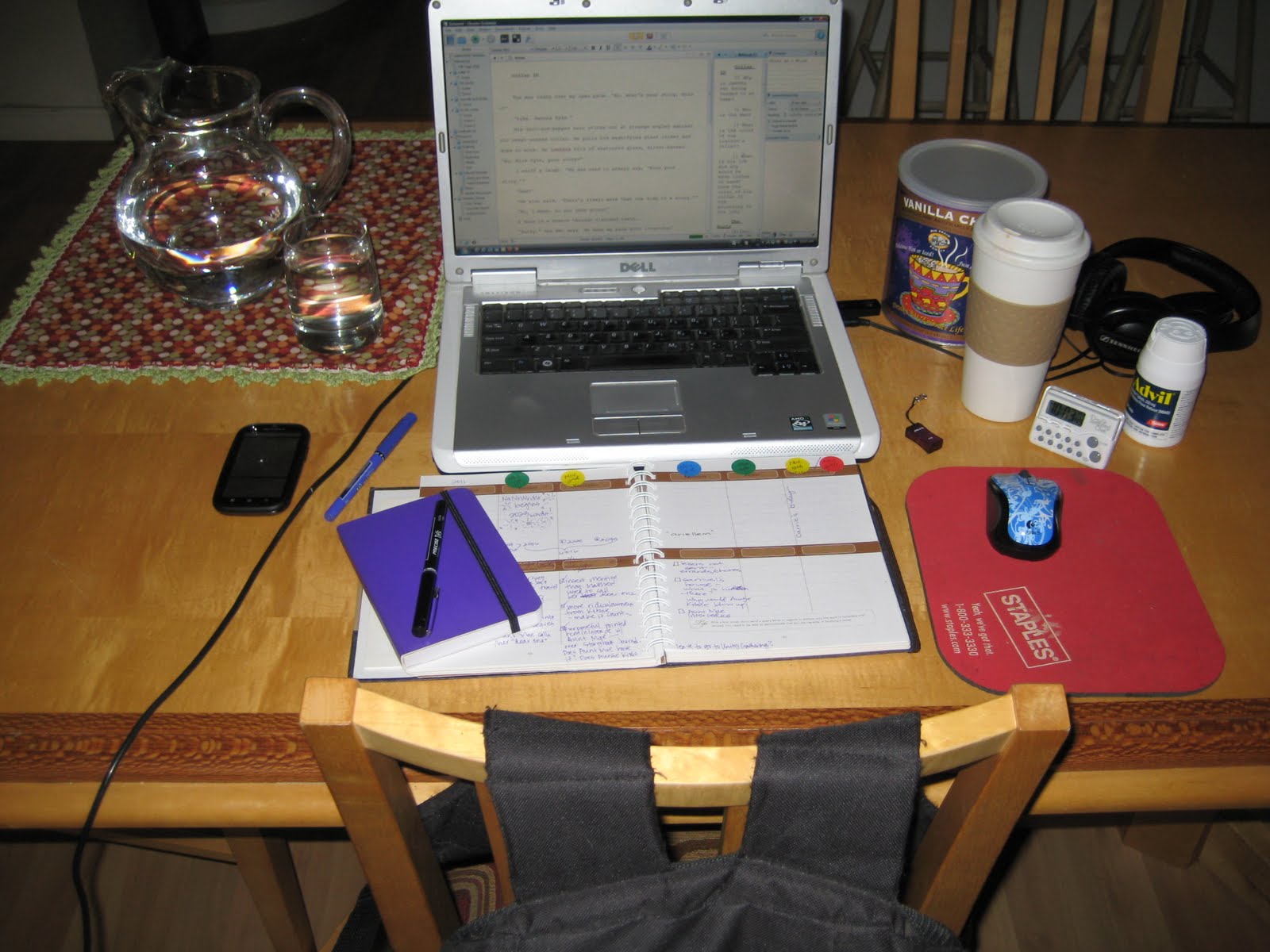
I'm slowly compiling a list of the things that are most crucial to my success over this month of Word-trackery.


  • pens. My favorite are the Pilot Precise rolling ball, extra fine. They are nice and smooth and you can get them in a multi-color pack which keeps note-taking creative and fun, and can help organize my thoughts into category-by-colors.
  • notepad. Small enough to fit in my purse and be used on the sly in case I hear a snippet of dialogue that strikes a creative chord, or see a crazy hat that I must write about.
  • Google Calendar phone app. Set with reminders to track my Write-ins.
  • Advil. Can't allow a headache to cripple my word count.
  • Big Train Vanilla Chai. Gotta wash down the meds with something, might as well taste good and keep me awake, to boot.
  • water. It's imperative to keep hydrated, which can help with avoiding the dratted headaches in the first place. Much as I love the taste of Vanilla Chai, nothing quenches like a tall glass of good water. And, yes. Thanks to my momma, I am a water snob. Aquafina, Dasani, or Sparkletts are the dessert waters of the H2O choices out there.
  • VOICE RECORDER!! This is one of my favorites. I discovered while writing the first book in the series that long bouts on the road are a goldmine for talking myself through plot road blocks. Simply turn off the music and ruminate out loud about all that could happen and usually the best course will outshine the rest and cause me to look ahead with great exuberance toward the night's writing appointment. But it is crucial that I record this brainstorming train of thought because, invariably, I will forget some of the details I was most excited about and then sit and waste time trying to remember them again when the time comes to write!
  • laptop. (with a charged battery for when I'm not near an outlet.) For those valuable opportunities to sit down and plug in to my manuscript.
  • Scrivener for windows-- with NaNoWriMo presets. What a great manuscript processing tool. You can set each text document with a goal, and it will track your progress in the footer with a bar that begins blank, turns red, then yellow, then green when you are in the final stretch of the day's word count goal. Nice visual encouragement.
  • headphones. To listen to music in public, so as not to be disturbed by chatty strangers.
  • thumb drive. to back up my writing, lest I lose everything. *gasp*
  • timer. To keep my fingers tapping away, or limit my research time.
  • backpack. A way to lug all this stuff around with me.
And that is how I've been able to manage so far. We'll see if I realize any other items of necessity as the month goes on.

Bring on the Reinforcements!


I reread my last post and thought what a defeatist tone it had when I said that I would be happy to say I survived, rather than won the NaNoWriMo challenge. So, to boost my drive, last night, hours before NaNoWriMo officially began, I posted on Facebook a request that friends and family enter their ultimatums for me if I don't reach my 50,000 word goal by November 30th. They came up with some gems, these among them:

I would have to:
--give a weekly sixty-minute massage for six months to my Mom.


--sew my friend a gypsy skirt.


--take my niece and nephew over night once a month for six months so my sister and her husband could have a date night. (they are a joy, so this one isn't so much of a threat as some of the others, but, as my mom lovingly refers to them, they can be energy vampires.)


--Provide dinner three nights a week, with drinks to boot, to a bachelor friend of mine. However he didn't specify a duration, so I'm assuming this is only for one week. His loss in not being more specific. ;)


--do all of my math-teacher-friend's grading for a month.


--cook a Christmas ham for another bachelor.


--Run a 5k with a questionable friend. Yech! I hate running. Why would you run, when God created so many other less-horrible ways of moving from one place to another?


So there you have it. More motivation to reach my goal.

I then proceeded to clean the house and brainstorm where to begin writing, sat down at my computer at 12:01am and my computer promptly crashed.

Of course.

I rebooted and finally was able to get started at 12:28am. Two-and-a-half hours later I had 2023 words under my belt and a positive beginning to a month-long task.

A NaNo or a WriMo?


I have 2 days and just over 8 hours left before NaNoWriMo 2011.

National Novel Writing Month was founded 1n 1999 by Chris Baty author of:


He and twenty-one friends took on the challenge to write a 50,000 word novel in 30 days. Some reached the goal. Others didn't. But the bug has spread worldwide.

This year, I'm joining the many ambitious writers who will take part in the frenzied, somewhat-social-but-not-so-much-that-it-holds-you-back, word-count focused event which is NaNoWriMo.

Now, because it is word-count focused and not really content focused, we are supposed to be at ease in the process, not needing to get every. word. right. Right now. But this also means we have to shut off the internal editor that wants to analyze each chapter, page, paragraph, sentence, word, punctuation, formatting, font choice. On and on.

I'm taking on the challenge of beginning the second book in my YA series. The first of which is in the final revision stages in the hopes that I would have sent out a query letter by the end of October. When fishing for an agent, the bait has to be set just right. This causes me to overthink things. I have to remember that in order to get a fish on my line, my hook does have to eventually get wet.

So, I'll be doing double duty for the first part of November-- finishing up my chapter summaries; crafting a tight, intriguing query; and making sure my sample chapters are in tip-top shape. As well as dive in to the highly-caffeinated NaNoWriMo world of words on paper. Okay, screens, too.

The participants of NaNoWriMo are sometimes called NaNo's, sometimes WriMo's. Since NaNo sounds like my trusty little mobile .mp3 player, and WriMo rings slightly of an over-large, thick-skinned herbivore I'm not sure which I relate to. By December 1st, I would love to say I "won" the challenge. But I'll settle for I "survived."


November's motto:
Write Now, Ask questions later.


Library Listening


I came across a document I created almost two years ago while doing research at the library. A group of three teenage girls came into the area where I was working and I typed up the overheard conversation, unbeknownst to them. Reading over it again, I realize I should do this more often. The tone of their chatter and their personalities and viewpoints were so clear, so natural. I loved it.

I've changed some personal information for the sake of anonymity, and instead of labeling the dialogue Girl#1, Girl#2, Girl#3 I've taken the liberty of giving them names.

---

Ashley- (looking at a fashion magazine) How long until Joe gets home?

Becca- Thirty minutes maybe.

Ashley- Okay.

Becca- So tonight it’s you and Joe and Charlie and me?

Ashley- I think.

Becca- What?!

Ashley- Well Isabel told me today that there is a girl in second period who likes Joe.

Becca- But he doesn’t like her back…

(Silence)

Becca- …Right?

(silence)

Becca- Let’s hope.

Ashley- …and he likes her back. So she was going to call him and ask him out.

(silence)

Tara- Oo, I like those shoes.

Becca- I like the way she dresses.

Ashley- Yeah.

Becca- I don’t even like Joe anymore. I went to karate the other day and he didn’t even notice anything was wrong with me. I mean, look at this. And I was limping by them, like this. Limping! And he asked what’s wrong with your shoe?

(silence)

Tara- Joe is difficult.

Ashley- Joe is difficult.

Becca- Joe is confusing and flirtatious.

(silence)

Becca- Charlie takes so long to text.

Ashley- So do you.

Becca- It’s not my fault you text fast

Ashley- It ain’t my fault if you text slow. And I don’t even have a full keypad.

Becca- I don’t have a full keypad either. Look.

(silence)

Tara- I’m re-doing my room.

Ashley- You are? Cool. I rearranged mine.

Tara- Look at that book.

Ashley- Go get it.

Becca- I read those in like elementary school

Ashley- I like the moral of the story.

Becca- Look at this text I just got. I don’t even know who sent it to me.

Ashley- What does it say?

(grabs phone)

Ashley- If you send this to 15 people you will get $100. If you send this to 25 people you will get $200.

Tara- Those things don’t work.

Ashley- Of course not, if it did the whole world would be happy.

Becca- Please promise me that if you can’t go out with Charlie you won’t go out with Joe.

Ashley- I won’t.

Becca- Then why do you want his phone number?

Ashley- Because I like to text people.

Tara- You are going to have to tell me about this whole Joe/Charlie thing.

Becca- Charlie is a new guy from Arizona who she likes and I do too. And I went out with Joe earlier in the year…

Ashley- But she broke up with him

Becca- … because he was a total flirt with everyone.

Ashley- And the weird thing is that he totally kept to himself when he was single but whenever he was with someone he flirts.

Becca- Yeah he’s all loud and saying “Hey, what’s up!”

Ashley- And smacking their butts!

---

... now, with drama like that, don't you wish I'd gotten more??

If you are going to attempt this, the key is to remain as invisible as possible. Avoid eye contact and do not, I repeat, do not react to anything they say to each other, or your cover will be blown. They will feel your intrusion on the conversation and it will lose its natural ring.


Happy dialogue stalking!

Gate Key Word Cloud

Wordle: Gate Key

This is my word cloud for Book One in my first YA series.

(created at www.wordle.net)

The Joy of Polishing at Year's End


For the past five years or so I've noticed that my writing tends to taper off once November rolls around. I was determined not to let this happen this year. At least not to the degree that it usually does.
It appears that I have not picked up my "regular broadcast" of the remaining 44 days of Pen on Fire, but, I am happy to declare that I have been writing and editing consistently still and am pretty pleased with the results.

As I was entering my penned edits from my hard copy into the digital file I was frustrated with the slowly increasing word count. Grrrrr. My manuscript is already longer than most agents are going to want to see for a first time author, and first book in a series. So, I decided to set myself a reasonable goal in order to downsize. Cut five words per page. Five words. That's so achievable. And that's almost 2,000 words less.

Snip, snip.

And wWhen I am finished, I can do it again.

:) Make every word count.

New Page-- "Sound"


Check out my new Page: Sensory Words-- Sound for a list of examples of onomatopoeia!


Sensory Words
Pages soon to come:
Sight
Taste
Touch
Smell


From,
the word nerd

PS After a long absence from the blogosphere, I will be returning shortly to a regular broadcast of the remaining 44 days of Pen on Fire, as well as other writerly musings. Thank you, most ardently, for your enduring patience. Adieu!

45 days of Pen on Fire


Inspired by the chapter "create a written snapshot" from Barbara DeMarco-Barrett's Pen on Fire.

Chapter Take-Away: How can I verbally evoke emotion while describing the mundane? Connect with a memory where I encountered similar feelings to that which my character is experiencing and extract empathetic details for the reader to latch onto as well.

Most of my friends "create a written snapshot" every time they post a Facebook Status, which is a great exercise at being vivid with imagery while adhering to an economy of words.

Who doesn't recognize the cuteness factor of a two year old pointing to a picture of Shamu (Sea World's famous killer whale, or orca) and calling it a "cow mermaid"?

Who doesn't understand what a three year old means when he says he feels "like a burned up french fry and a dead fish" right before throwing up?

Who wouldn't crack up at a four year old boy running through the house naked, yelling, "Michelangelo! Michelangelo! Michelangelo!"?
OR
Being torn between a laugh and a sympathetic whimper when a woman is afraid she has somehow become invisible because of the way people look past her and one of her friends sets a picture of a blank wall on his cellphone to display when she calls.

***

Now there are also ways of drawing a word picture by forming correlations with the things around a character. When my character Dannen is contemplating being sent away while laying on his back in an open field behind his grandpa's house, he finds a parallel between his situation and the clouds above him:

' Wide blue sky and pale wisps of cloud swept above him. These clouds weren't quite as impressive as the billowing pillar to the east, still visible, still unchanged. But he could relate to these-- disconnected, blown about by the wind.
Soon they'd be gone too. '

TRY YOUR HAND: Write a scene about a character standing outside a building.
Where are they? Insert sensory details: sight, sound, smell, touch...
Why are they there?
Now what is the character struggling with internally?
Is he trying to talk himself into going in? What is preventing him?
Is she trying to convince herself to walk away? What is she tempted to do in there?
Or has he just left and he's afraid of the consequences of what just transpired?
How can your past experiences add richness and authenticity to the scene?

46 days of Pen on Fire


Inspired by the chapter "first lines" from Barbara DeMarco-Barrett's Pen on Fire.

Chapter Take-Away: Find a good first line to work with-- if it hooks you and pulls you through the story it's done its job even if you end up using another first line in the final draft.

If you're going to write, you need an arsenal of good first lines, you need good first lines at your Book's opening, at chapter beginnings and after section breaks. As author Jack Cavanaugh said at the San Diego Christian Writers' Guild 2009 Fall Conference, you don't want to give your readers a good place to put down your book, rather you want to give them every reason to blame you for sleep-deprivation.

These are the series of first lines which got me through my first and second draft:

* He knows, she thought.
* As he sat in classroom 4-A listening to the other kids talking about their summer plans, his spirits dug a ditch and crawled in.
* Fifteen-year-old Dannen Pyke broke into a run.
* A shadow passed in front of his eyelids and he opened to see a figure looming over him.

I am now down to the following two for my opening options in my final draft:

* The Watcher perched on the roof of a convenience store, his wings extended behind.
* The first time Dannen noticed the clouds that didn't change was on the way to Grandpa Joe Moses' house to be dumped for a summer of exile.

And as I look through my short list of first lines for future projects I find the following:

* The doctor leaned over her open palm.
* Let me make this abundantly clear: this story is not about me.
* Tomorrow my life ends.


Here are some good first lines-- let's see if we can dissect them and find out why they are good.

1)
That fool of a fairy Lucinda did not intend to lay a curse on me.
(Ella Enchanted, by Gail Carson Levine)
WHY is it good?
It shows personality.
It tells the genre (fairytale).
It presents a problem-- a curse,
and reveals Point of View: first person.

2) Late on a full-mooned Sunday night, the two figures in work clothes appeared on Highway 27, just outside the small college town of Ashton. (This Present Darkness, by Frank E. Peretti)
WHY is it good?
It gives the location
and time of day--
with a hint of mood in the details.
It gives a ring of the mysterious:
these figures "appeared"
as from out of nowhere,
so we can expect the extra-ordinary in this book
and it begs the question Why have they appeared?

3) It began one day in summer about thirty years ago, and it happened to four children.(Half Magic, by Edward Eager)
WHY is it good?
It, again, gives a time frame
and season.
It tells who the main characters are going to be
and hooks the reader with the detail "it happened"--
You naturally have to know what "it" is.

4) When the city of Ember was just built and not yet inhabited, the chief builder and the assistant builder, both of them weary, sat down to speak of the future. (The City of Ember, by Jeanne DuPrau)
WHY is it good?
It states the place.
That it was just built and not yet inhabited are
intriguing details.
And the fact that the chief builder and assistant are both weary
is a telling fact as well,
when you would expect excitement
even celebration
over their finished project,
whose purpose is about to be realized,
their somber mood suggests something about
the city's perhaps less-than-bright future.

5) Wind howled through the night, carrying a scent that would change the world. (Eragon, by Christopher Paolini)
WHY is it good?
The detail of howling wind anchors the reader in an expectation of something ominous.
It grips the reader with a need to know what the scent is?
And it announces a promise: the world is about to change.

Reader Input:
What is your favorite first line? What book? What author?
And, alternately, what is the first line of your favorite book?
Finally, can you pinpoint WHY it is good?

47 days of Pen on Fire


Inspired by the chapter "harvesting words" from Barbara DeMarco-Barrett's Pen on Fire.

Chapter Take-Away: You must know a word intimately before you can use it and make it authentic. Same goes for your characters. If they haven't been exposed to a word correctly and impactfully, they can't use it with any degree of believability.

I love words. I love the way they sound, the way they play with the words around them, the way they sketch images in our minds and ignite fires within us.

I'm determined to keep a word journal, and I might just attach it to this blog for posterity and for the use and enjoyment of my readers. The journal would be made up of--
1. Words overheard
2. Words read
3. Words harvested from the dictionary
and lastly,
4. slang, or what I will from now on refer to as faux-cabulary

So, here are the words that I gleaned this week which have stuck with me.

Faux-cabulary

My first example was a misspoken term in Sunday's sermon, but I think it is delightfully valid.

ambassenger \am BASS en jer\ noun 1. A representative of his or her Sovereign who communicates a message of Truth.

other great words of the week...

Overheard:

conflagration \con fluh GRAY shun\ noun 1. Fire, especially a large disastrous fire.
2. War, conflict.

Read:

profligate \PRAW flih geht, -gayt\ adjective 1. Completely given up to dissipation and licentiousness.
2. wildly extravagant, prodigal.

vitriol \VIH tree uhl\ noun 1. a sulfate of any of various metals (as copper, iron or zinc), especially, a glassy hydrate of such a sulfate.
2. something felt to resemble vitriol especially in caustic quality. Virulence of feeling or of speech.

Reader Input: What were your favorite words you heard, read, or looked up this week?
Do you have any faux-cabulary to share?

48 days of Pen on Fire


Inspired by the chapter "load the basket, fill the jug" from Barbara DeMarco-Barrett's Pen on Fire.


Chapter Take-Away: Attack your project daily, doggedly-- gather kindling from conversations overheard, newspaper articles, candid photos, facebook posts, and situations that pin you down and tickle until your fancy cries "uncle."


Candid Photo fodder--

The bus rumbles and bumps through the green El Salvadorian landscape, winding through the verdant mountains and out of town, away from the respectable neighborhoods to a plain of refuse. Some would label the inhabitants along the same lines as their surroundings: waste. Broken aluminum, tires and tarps lean at crude angles to supply shade and shelter. Occasional mismatched shoes and grimy shirts clothe the dust-covered little ones who roam about the garbage that is their home.
We've arrived, but it feels as if we aren't really here. We dismount the bus and the smell of rot, of dry and dirty trash, of urine, assaults our senses. This is real. This is poverty.
The children gather and sing songs of praise to Jehovah-Jireh, the Lord who Provides, and eat rice and chicken provided out of the visitors' abundance. A five-year-old girl with eyes round with innocence and caution waits to eat until she's sure her younger sister has had enough, and my heart collapses. I don't speak in the same tongue as her, but her language of selflessness and love breaks through with perfect clarity. And a simple sweetness embeds itself across the memory crying out that this day has not been wasted.

49 days of Pen on Fire

Inspired by the chapter "freewriting shall set you free" from Pen on Fire, by Barbara DeMarco-Barrett


Chapter Take-Away: Create a Freewrite Topic Pile.
What is freewriting, some may ask? It is a method used by many writers to get the creative rain gutters unclogged. Here's how it works, take one or more evocative words or phrases as a starting point and set a timer. The key: write for the allotted time without stopping, without editing, without second guessing. Silence the inner critic and allow stream-of-consciousness to roam free.

I don't yet have a Topic Pile, so while working on my first freewrite I stole two words from nearby books with the open-and-blindly-point approach. I landed on "alarm" and "squashed this selfishness" and allowed myself five minutes.
It was not a stellar writing accomplishment, but it definitely gave me mental pictures to work with.

READER INPUT: Post three unrelated words or phrases that I may add to my Freewrite Topic Pile.

50 days of Pen on Fire


While editing and revising my young adult novel, I am challenging myself to not become stale in writing fresh words as well. So, I endeavor to tackle 50 days of Pen on Fire, inspired by Barbara DeMarco-Barrett's book Pen on Fire, a busy woman's guide to igniting the writer within.

Beginning with the "Getting Started" section I will use a chapter a day (Monday through Friday, though since I'm starting mid-week the first few chapters will be posted same day to catch up) and I will wrap-up with the "Overcoming the Obstacles" section. Finally there are four chapters at the end which will put me past the nice round 50 days, but I will most likely complete those as well.

The goal: each day I will include a snippet of my 15 minutes of free-writing, and my take-away from the chapter. I may give a "try your hand" challenge for my readers, or ask for additional input.
So there you have it-- the first installment, inspired by the chapter "stolen moments", follows...

Chapter Take-Away: Notwithstanding the LORD's ability to make the sun stand still in the middle of the sky (Joshua 10:13), I need to diligently redeem the time that I have been given to accomplish the roles set before me: wife, writer, secretary, Sunday school teacher, etc. Since I cannot increase the number of hours in a day, I have to take time from somewhere else, the most obvious being sleep-- Oh, how I love my 8 hours of sleep-- but also to narrow the time it takes for my various other responsibilities throughout the week, so I don't have to be crippled by the fear of neglecting my roles.

  1. First things first-- The Lord shall receive the firstfruits of my day. I commit to God my first waking hours, to prayer, and the renewing of my mind by reading and submissive contemplation of His word.
  2. Next, morning chores.
  3. Followed by office hours at the shop.
  4. Blocking out two hours of writing time upon returning home.
  5. Dinner prep.
  6. Husband time.

All the while, stealing moments for writing amidst the day's duties. Setting a timer, and not stepping away until those fifteen minutes are fulfilled.

READER INPUT?: the timer method works wonders for me in my chores and in my writing? What do you do in order to diligently and effectively take on a challenge?


Vanity of Vanities


A Wise Reminder...

STOP! Listen to the Word of God

"Do nothing out of selfishness or empty conceit, but with humility of mind regard one another as more important than yourselves;" Philippians 2:3

SLOW DOWN! Consider all that it means

Part of regarding others as more important than ourselves is not getting upset when they agree.

How very often we need this exhortation.

  • When driving, for instance?
  • At church?
  • At school?
  • In ministry?
  • With our friends?
  • With our family?
  • With enemies?
  • With teachers?
  • With authority figures?
  • At work?
  • While waiting in line?
GO! Practice What is Preached

"Faith without works is useless" James 2:20B

How can you put this Truth into action in your life today?

As Long as it Takes


Lately, I've felt beaten down every time I miss a self-imposed deadline for myself, and then I have to remember: Life Happens.

I went on a snow trip to Park City, UT last week and hadn't been on a snowboard in three years and it had been five years prior to that. With that much time in between I feel like I'm re-learning everything: balance and strength, confidence on both edges, boldness to cut turns (and wouldn't you know I'd be goofy-footed on top of it all).

I'm a cautious snowboarder, as well, which tends to make me nervous that some other riskier newbie is coming up behind me and is going to plow me over. Yeesh. But I returned in one piece, with wonderful soreness to prove what a great workout it was out there.

So what does this have to do with writing and deadlines? Let me draw a bit of a comparison...

BE CONSISTENT

Writing takes consistency. If I wait too long in between I can feel like I'm learning all the basics over again. But, man! When I give it the time, even if I've been slacking up until that point, it feels SO GOOD to get the kinks worked out and exercise those atrophied muscles, and maybe even labor with some that I forgot I had.

KNOW YOUR WEAKNESSES

My first attempt at snowboarding I caught the wrong edge and landed on my backside, clutching my wrist to my chest, unable to take a breath. And I was at the base of the mountain. I had to sit out for the rest of the weekend and was convinced I'd broken my wrist. I later found that it was only a bad sprain, but my manual capabilities were drastically diminished afterward.

Since then I have added wrist guards to my repertoire and fall with a lot more confidence. :)

In writing, I know that I have difficulty showing emotion rather than telling my reader what the character is feeling, so I add tools to my repertoire-- I make a note when I read a good example of showing emotion. If I watch a TV show or a movie that is rich with emotion I can exercise my craft by attempting to capture the emotion of the scene in words.

When I reinforce my known weak spots, I give myself the opportunity to turn them into strengths.

GET A LITTLE HELP FROM YOUR FRIENDS

I have funny friends. I have clever relations. That used to discourage me. I'd think, I'll never be as naturally funny as Tim, or Danielle, or Charissa, or Kate and I'd lean toward shutting down. Can I just say-- that's stupid. (Or as Danielle would say, "That's tarded again.") It doesn't matter if I don't have Tim's quick wit-- I have time on my side when I'm writing a book. It's okay if I'm not situationally clever like Danielle, or vocabularily astute like Charissa, or don't possess a humorous outlook like Kate. I don't have to be those things. I can make things up as I go-- or I can borrow.

On our snow trip I needed a good jacket and my friend had one. In fact they gave me the newest one they owned and it served me well. So well, in fact, that I had to unload some of my own layers in order to not overdo it with the warmth.

Having cleverness and wit that surrounds me is a blessing, and, luckily, with friends who are generous, I can borrow from their stores and bring character and situation to life on the page in a way that pays tribute to the inspirational people in my life.

WORK AT YOUR BEST PACE

Next, I needn't worry about those who are sweeping past, and maybe even cutting fancy turns and whizzing by like a pro when I'm flat on my derriere. Again. I push myself up, brush myself off, and stop trying to be someone else. It doesn't matter how many times I fall, whether I fall up the mountain or down it, no matter how many barriers appear to be in my way, no matter how many times I catch the wrong edge or seem to lose my bearing on the peak. My work will take as long as it takes and when I finally arrive-- when I've reached the bottom of the mountain-- I'll have something to show for my work that no one else has written... and as so many professionals remind me... that no one else could have written.

So, I press on.

Write on, writers. Write wisely.